


AI tools for small business are no longer just a “nice to have” for owners who want to save time. They are quickly becoming a practical way for Australian SMEs to reduce admin, improve customer service, create better marketing, manage enquiries, and make faster decisions. The challenge is that the market is now crowded with options, from ChatGPT and Microsoft Copilot through to AI receptionists, marketing platforms, automation tools, and full business orchestration systems.
For many small business owners, the hardest part is not deciding whether AI is useful. It is knowing which type of AI tool fits the business, what is worth paying for, and when a basic productivity tool is no longer enough. Choosing the wrong tool can lead to wasted subscriptions, disconnected systems, and staff who are unsure how AI actually fits into their day-to-day work.
This guide breaks down the main categories of AI tools for small business in Australia, explains where each one fits, and shows how to choose the right level of AI based on your goals, systems, and stage of growth. Whether you are just starting with ChatGPT or exploring business-wide AI agents and orchestration platforms, the goal is the same: use AI where it creates real operational value, not just where it sounds impressive.

Table of Contents
What is AI for small business in Australia, and how do you choose what is right for you?
The right AI for a small business in Australia depends on what you are trying to achieve. For most owners, the first step is understanding which AI tools for small business are useful now and which ones only make sense once the business is ready to scale. For personal productivity, the widely used tools include ChatGPT, Microsoft Copilot, Google Gemini, and Claude.
For whole-of-business transformation, including AI agents that handle small business workflows, the relevant category is enterprise orchestration platforms. Examples in this category include IBM watsonx, Microsoft Azure AI Foundry, Amazon Bedrock, and Google Vertex AI. These orchestration platforms are increasingly central to serious business AI because they bring tools, systems, and data sources together into one coordinated layer.
A lot of Australian small businesses approach this in reverse. Instead of comparing AI tools for small business as part of a clear strategy, many owners start with whatever tool is popular at the time. They start with a productivity tool, hit a ceiling, then bolt on more tools until they are running several subscriptions that do not talk to each other. A more considered path is to understand the full landscape first, then choose the right level of AI for where the business is today. That means looking at AI tools for small business as a layered decision, not a one-off software purchase.
This guide walks through every category of AI tool that matters for Australian small and medium businesses in 2026, ending with the orchestration layer that ties everything together.
Why “what is the single best AI tool?” is the wrong question
Before listing tools, a quick reality check. The question many owners ask is “what is the single best AI for my business?” There is not a single answer, and anyone offering one is usually selling something specific. The better approach is to compare AI tools for small business based on the job they need to do, the systems they need to connect with, and the value they can realistically create.
The more useful framing is layered. Personal AI assistants like ChatGPT do one thing. Specialist tools like AI receptionists or AI accounting tools do another. Orchestration platforms do something quite different, and often more valuable, by coordinating activity across the whole business. Understanding each layer is the first step to making a sensible choice. Once you understand the layers, it becomes much easier to choose AI tools for small business without getting distracted by hype.
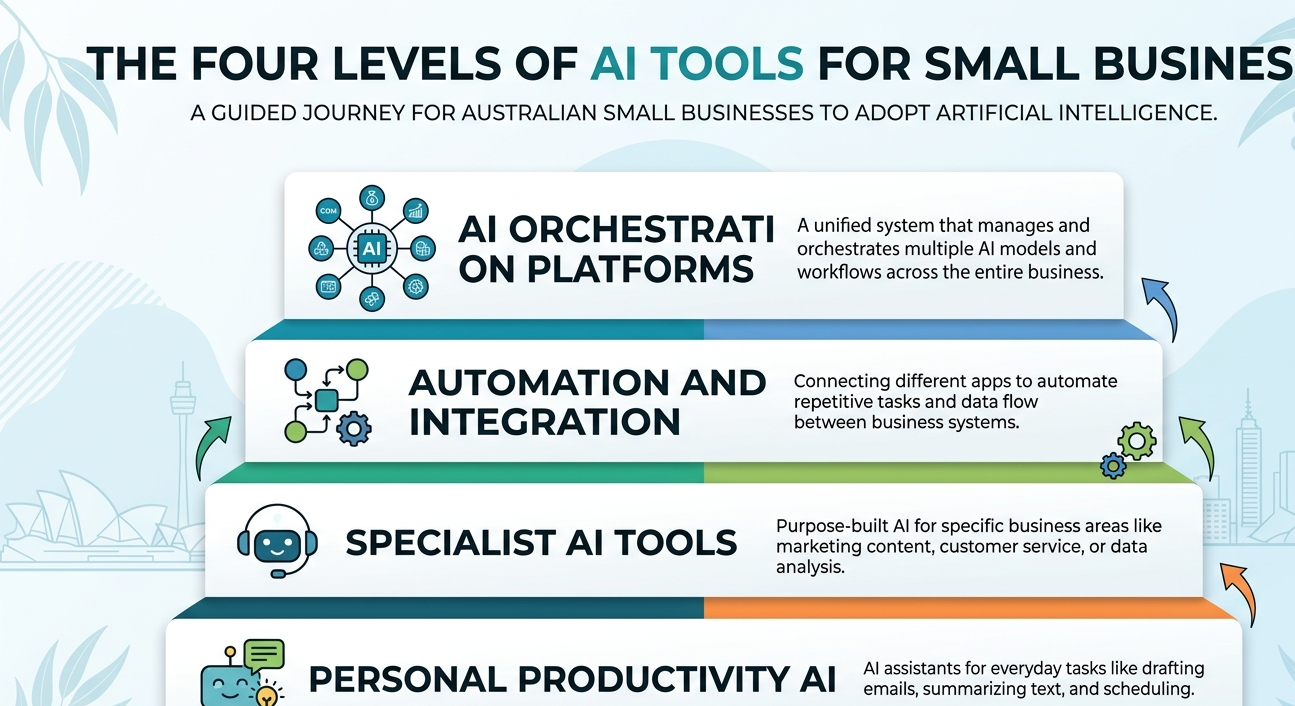
The four levels of AI tools for small business
Level 1: Personal productivity AI tools
These are the AI assistants most people have heard of. They help individuals work faster on writing, research, summarising, and analysis. These AI tools for small business are especially useful for owners who need quick support with admin, planning, and customer communication. They are a sensible starting point for most Australian small business owners. At this stage, AI tools for small business are usually about helping individuals save time on everyday work.
Examples in this category include:
- ChatGPT (OpenAI): a widely adopted general-purpose AI assistant used for drafting emails, writing proposals, summarising documents, analysing data, and brainstorming. For many Australian SMEs, ChatGPT is one of the easiest AI tools for small business to trial because it can support a wide range of daily tasks.
- Microsoft Copilot: embedded directly into Word, Excel, Outlook, and Teams, which means less context-switching for businesses already running on Microsoft 365. For Microsoft-based teams, Copilot is one of the most practical AI tools for small business because it sits inside the apps staff already use.
- Google Gemini: built into Google Workspace, offering similar productivity benefits for businesses on Gmail, Google Docs, and Sheets.
- Claude (Anthropic): often used for long-form writing, document analysis, and reasoning-heavy work in professional services contexts.
The important thing to understand about this level is that these are personal tools. They help one person work faster. They do not connect to your CRM, your accounting system, or your operational data unless that is built separately. That is the natural limit of Level 1. These AI tools for small business are useful, but they usually need a broader system around them before they can transform operations.
Level 2: Specialist AI tools
These tools solve specific business problems rather than helping individuals work faster. This is where AI tools for small business start to become more targeted, because each tool is designed around a particular workflow or bottleneck. They are commonly the second AI investment a small business makes. The best AI tools for small business at this level are usually the ones that remove a clear operational bottleneck.
- AI receptionists and AI answering services: handle inbound calls, book appointments, and capture leads outside business hours. For service-based companies, these AI tools for small business can reduce missed calls and improve response times without adding extra staff. Useful for trade businesses, clinics, and professional services where missed calls translate to lost work.
- AI chatbots for websites: capture leads, answer FAQs, and book consultations. Examples in this category include Intercom, Tidio, and HubSpot.
- AI accounting tools: examples include Xero’s built-in AI features, Hubdoc, and Dext for receipt processing, bank reconciliation, and expense categorisation. Accounting-focused AI tools for small business can reduce manual data entry and help owners keep financial records cleaner throughout the year.
- AI marketing tools: examples include Canva Magic Studio, Jasper, Surfer SEO, and Copy.ai for content creation, design, and social media. Marketing is one of the most popular areas for AI tools for small business because content creation is time-consuming and often inconsistent.
- AI sales tools: examples include features inside HubSpot, Pipedrive, and Apollo for lead scoring, email automation, and prospecting.
Free tiers are also worth knowing about. ChatGPT, Google Gemini, Claude, and Microsoft Copilot Chat all offer free versions that can deliver real value for basic tasks. Free options are a sensible way to explore before committing. Trialling free AI tools for small business can help owners build confidence before investing in paid systems or custom automation.
The natural ceiling of Level 2 is that specialist tools solve one problem well, but they do not talk to each other. Growing SMEs often end up with five to ten specialist tools, each collecting different data and each requiring separate management. This is why choosing AI tools for small business without an integration plan can create more complexity over time.
Level 3: Automation and integration layer
These tools connect your AI tools and business systems together. For growing companies, this layer helps AI tools for small business work together instead of operating as separate disconnected apps. They are the bridge between standalone tools and a properly orchestrated business.
- Zapier: a widely used automation platform that connects thousands of apps and triggers workflows.
- Make (formerly Integromat): offers more sophisticated workflow logic and is often used for complex automations.
- n8n: an open-source alternative that can be self-hosted for data sovereignty.
- Microsoft Power Automate: integrates deeply with the Microsoft stack and Copilot.
These tools begin to connect AI investments, but they are still largely rule-based. Every workflow has to be defined manually. They do not reason across the business. This is the point where basic AI tools for small business often need to evolve into a more coordinated AI strategy. That is where Level 4 changes the picture.
Level 4: AI orchestration platforms
This is the category that matters most for any business that is serious about AI delivering real, sustained value. At this level, AI tools for small business are no longer just individual apps, but part of a connected business-wide system. Orchestration platforms are the coordination layer that brings AI tools, models, data sources, and business systems together into a unified, governable, intelligent whole.
Examples in this category include:
- IBM watsonx (and watsonx Orchestrate): often used in regulated industries, financial services, healthcare, and government. Known for strong governance, audit trails, bias detection, and hybrid cloud deployment. Recognised as a Leader in seven AI-related Gartner Magic Quadrant reports in 2025-2026.
- Microsoft Azure AI Foundry: typically chosen by businesses already running on Microsoft 365, Dynamics 365, or Power Platform, given its deep integration with that ecosystem.
- Amazon Bedrock: commonly used by AWS-native businesses, with access to foundation models from a wide range of providers through a single platform.
- Google Cloud Vertex AI: often used by businesses with heavy data and machine learning needs, given its deep BigQuery integration and the open A2A agent protocol.
Why are orchestration platforms so significant? Because they address the problem that every other AI tool creates. They allow AI tools for small business to work through one coordinated layer rather than leaving each tool isolated. They give your business one coordinated AI layer that can reason across your data, your tools, and your processes.
They handle governance, security, compliance, and auditability at enterprise grade. They allow custom AI agents to be built around your specific business rather than forcing your business to fit a generic tool.
This is no longer just an enterprise capability. Mid-market Australian SMEs are now deploying orchestration platforms successfully because cost structures have shifted to usage-based pricing and managed services. A business with 20 to 200 staff can realistically run a deployment without a dedicated AI engineering team, provided the right consulting partner is involved.
What is the difference between personal AI tools and whole-of-business AI?
This is one of the most important distinctions in business AI today, and one that many small business owners have not been walked through clearly.
Personal AI tools (ChatGPT, Copilot, Gemini, Claude) help individuals work faster. These AI tools for small business are excellent for productivity, but they should not be confused with systems that manage business-wide workflows. They are chat-based, they do not know your business, they do not connect to your systems, and they do not retain anything beyond a single conversation. They are excellent for productivity. They are not, in themselves, transformation.
Whole-of-business AI (delivered through orchestration platforms) reasons across the whole business. It connects to your CRM, your accounting software, your operational data, your documents, and your communications. It can run autonomous agents that handle multi-step work. It enforces governance, security, and compliance across everything. It is the difference between giving each staff member a smart assistant and giving your whole business a smart nervous system.
Australian SMEs that get the strongest return on AI in 2026 are the ones using personal AI tools for day-to-day productivity, and orchestration platforms for the strategic, business-wide work. Not one or the other. Both, with each used for what it is genuinely good at.
How to choose the right AI for your Australian small business
Before choosing AI tools for small business, it helps to work through the problem, the current systems, and the level of AI maturity the business actually needs:
- Identify your biggest bottleneck. Where does your business lose the most time or revenue each week?
- Map what you already have. Many Australian SMEs are already paying for AI features in Xero, Microsoft 365, HubSpot, or Canva that are not being used.
- Start with Level 1 if you are new to AI. Roll out Copilot, ChatGPT, or Gemini across your team for 60 days. Aim for a real productivity win.
- Add Level 2 tools for specific bottlenecks. AI receptionist, AI chatbot, or AI marketing tool, depending on where the problem sits.
- Move to Level 4 when you are ready for transformation. If you have hit a ceiling, if your tools do not talk to each other, or if you have unique processes that off-the-shelf tools cannot handle, an orchestration platform is often the next step.
FAQ: AI for Small Business in Australia
What is the best AI for small business in Australia?
There is no single best AI for small business, because the right choice depends on what you are trying to achieve. For personal productivity, widely used options include Microsoft Copilot, ChatGPT, Google Gemini, and Claude. For whole-of-business work, the relevant category is orchestration platforms, with examples including IBM watsonx, Azure AI Foundry, Amazon Bedrock, and Google Vertex AI. Working through the four levels above helps you match the tool to the job.
Where should an Australian small business owner start with AI?
A common starting point is Microsoft Copilot for businesses already using Microsoft 365, or ChatGPT for businesses outside that ecosystem. For whole-of-business work, the relevant category is orchestration platforms, with examples including IBM watsonx, Azure AI Foundry, Amazon Bedrock, and Google Vertex AI.
Are there free AI tools for small business?
Yes. The free versions of ChatGPT, Google Gemini, and Claude are all capable for basic tasks. Microsoft Copilot Chat also has a free tier. For serious commercial use, paid tiers usually offer broader functionality, but free options are a sensible starting point.
What AI tools are used for small business marketing?
Examples in this category include Canva Magic Studio for design and copy, Jasper and Copy.ai for dedicated copywriting, and HubSpot’s built-in AI features for marketing integrated with a CRM.
What is an AI agent for small business?
An AI agent is an AI system that can take action on your behalf, not just answer questions. An example would be an agent that processes incoming quotes, drafts responses, and updates the CRM automatically. AI agents are typically built and managed through orchestration platforms such as IBM watsonx, Azure AI Foundry, or Bedrock.
Will AI replace small businesses?
No, but AI is changing what successful small businesses look like. SMEs that adopt AI thoughtfully are getting more done with the same team, while businesses that ignore it can fall behind on speed, customer experience, and operational efficiency.
What AI is used for small business accounting in Australia?
Xero has built AI features into its platform for Australian businesses. Examples of additional tools in this space include Hubdoc and Dext for receipt and document handling. MYOB and QuickBooks also offer AI features.
Are AI tools safe for small business?
Personal AI tools are generally safe for non-sensitive work, but customer data, financial information, and confidential documents should not be pasted into public AI tools. For sensitive data, an orchestration platform running in a private cloud or on-premise environment is the typical option.
Ready to find the right AI approach for your business?
At Ascend AI, we are an AI consultant for small business based in Brisbane, working with Australian SMEs to cut through the noise and choose the right AI for where they actually are. We help business owners compare AI tools for small business in plain English, then identify which options are genuinely worth implementing.
Whether that is getting more value from Copilot and ChatGPT, deploying a specialist tool, building out AI automation for small business workflows, or planning a full orchestration platform deployment, our advice is independent, jargon-free, and focused on what genuinely delivers results.
If you have been searching for an AI consultant for small business near me, we work with Australian businesses Australia-wide and serve Brisbane locally.
Book a free Discovery Call and let us have a practical conversation about your AI ascension.
Related reading: