


AI in health and aged care is rapidly reshaping how providers deliver care, manage operations, and meet increasingly complex regulatory requirements. Across hospitals, aged care facilities, disability services, and community health organisations, artificial intelligence is moving beyond experimentation and into practical, measurable use.
Australian healthcare providers face rising demand, workforce shortages, tighter funding, and heightened expectations around safety, transparency, and quality outcomes. At the same time, care teams are under growing administrative pressure, often spending more time on documentation than direct patient or resident interaction. In this environment, AI in health and aged care provides practical tools to relieve pressure without compromising care standards.
AI offers a powerful solution to these challenges. This is where AI in health and aged care delivers value by removing friction across clinical, operational, and compliance workflows. When applied responsibly, AI enables health and aged care organisations to operate more efficiently, deliver more Personalised care, strengthen compliance, and protect sensitive clinical data. Rather than replacing clinicians or carers, AI supports them by removing friction, reducing manual workload, and improving access to accurate, timely information.
This article explores how AI in health and aged care is transforming operations, elevating patient and resident experience, strengthening compliance, and securing digital health assets. AI in health and aged care is becoming essential for providers seeking to balance care quality, compliance obligations, and operational sustainability.

Table of Contents
Enhancing Operations with AI in Health and Aged Care
Operational efficiency is one of the most immediate benefits of AI adoption in healthcare and aged care settings. Many providers still rely on fragmented systems, paper-based workflows, and manual processes that slow service delivery and increase risk.
AI-powered automation enables organisations to streamline administrative tasks that traditionally consume valuable clinical time. Within day to day operations, AI in health and aged care reduces duplication and improves coordination between systems and teams. Intelligent systems can assist with clinical documentation, referrals, rostering, appointment scheduling, and workforce planning, allowing clinicians and care workers to focus on delivering high-quality care rather than managing paperwork.
Predictive analytics plays a critical role in workforce optimisation. By analysing historical staffing data, resident acuity levels, seasonal trends, and service demand patterns, AI can forecast staffing requirements more accurately. This reduces reliance on agency staff, supports continuity of care, and helps organisations manage labour costs more effectively. For workforce planning, AI in health and aged care supports more stable staffing models and improved continuity of care.
AI-driven decision support tools also improve data accuracy and reliability. These systems can identify inconsistencies, missing information, or potential risks within patient records and care plans. By flagging issues early, AI supports safer clinical decision making and reduces the likelihood of adverse events caused by incomplete or outdated information.
Generative AI further enhances operational efficiency by assisting with shift handovers, discharge summaries, progress notes, and internal communications. Rather than starting documentation from scratch, clinicians can review and approve AI-generated drafts, significantly reducing time spent on administrative tasks.
When combined with workflow automation, AI can integrate electronic health records, medication systems, compliance platforms, and workforce tools into a single, connected ecosystem. This creates a consistent source of truth across the organisation and supports better coordination between teams.
Elevating Patient and Resident Experience Through AI
Improving patient and resident experience is a core objective of AI in health and aged care. Beyond operational gains, AI enables more proactive, personalised, and human-centred care. From the resident perspective, AI in health and aged care enables more timely communication and proactive support.
AI-powered virtual assistants are increasingly used to support patients, residents, and families outside traditional care hours. These assistants can help with appointment bookings, medication reminders, care updates, and frequently asked questions. This improves accessibility, reduces frustration, and enhances communication across the care journey.
Natural language processing allows complex medical information to be translated into clear, easy-to-understand summaries. This supports informed consent, improves engagement in care planning, and helps families better understand treatment options and ongoing care requirements.
Predictive analytics plays a vital role in early intervention. AI models can analyse behavioural patterns, clinical data, and historical incidents to identify residents at risk of falls, deterioration, or behavioural escalation. Early alerts allow care teams to intervene proactively, improving safety outcomes and quality of life. This preventative capability is a key strength of AI in health and aged care .
Sentiment analysis adds another layer of insight. By analysing feedback, staff notes, and complaints data, AI can detect subtle indicators of dissatisfaction, distress, or declining wellbeing that may otherwise go unnoticed. This enables organisations to respond faster and address concerns before they escalate.
AI-powered triage tools also support frontline staff by routing alerts, requests, and queries to the most appropriate team member. This shortens response times, reduces cognitive load on staff, and ensures that issues are addressed efficiently and accurately.
Improving Compliance and Quality Assurance with AI
Compliance and quality assurance are critical priorities across the Australian health and aged care sector. In regulated environments, AI in health and aged care helps organisations move from reactive audits to continuous assurance. Providers must meet strict accreditation standards, safety benchmarks, and reporting obligations while demonstrating continuous improvement.
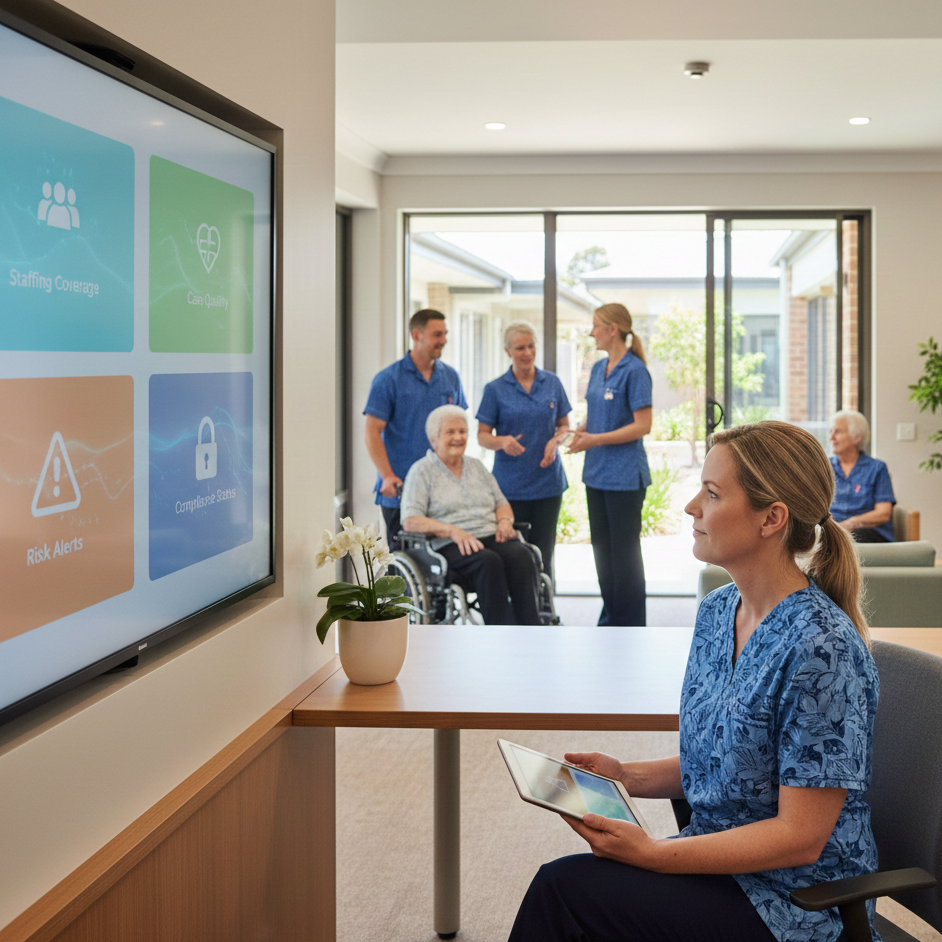
AI-based compliance monitoring systems enable organisations to track performance in real time across safety, quality, and service metrics. Rather than relying on retrospective audits, providers gain ongoing visibility into compliance status and emerging risks.
Generative AI supports documentation consistency by drafting incident reports, accreditation submissions, audit responses, and continuous improvement plans. This reduces administrative burden while ensuring that documentation aligns with regulatory requirements and organisational standards.
Automated record checks further strengthen compliance by verifying the completeness and timeliness of care notes, medication charts, and consent forms. AI systems can flag missing information before audits or inspections, reducing risk exposure and improving readiness.
Machine learning models can also identify patterns across incidents, complaints, and medication errors that suggest systemic issues. These insights allow organisations to address root causes rather than responding to individual events in isolation.
AI-enabled training platforms enhance workforce capability by assigning personalised learning modules based on staff roles, incident history, and compliance needs. This supports a culture of continuous improvement and helps ensure staff remain aligned with evolving regulatory expectations.
Securing Digital Health Assets in an AI-Driven Environment
As healthcare systems become more digital, protecting sensitive information is essential. AI in health and aged care plays a critical role in strengthening cybersecurity and information governance.
AI-powered threat detection tools monitor networks for unusual activity, unauthorised access attempts, and emerging cyber threats. Automated responses help contain incidents quickly, reducing the risk of data breaches and service disruption.
Intelligent access controls ensure that only authorised personnel can access patient records, care notes, and internal systems. Role-based permissions support safe practice while maintaining operational efficiency.
AI can also automate document classification, encryption, and secure storage. By accurately tagging sensitive information, organisations improve data governance and reduce the risk of accidental exposure.
Generative AI supports privacy protection by automatically redacting identifying information from documents used for audits, training, or external sharing. This ensures compliance with privacy obligations while enabling knowledge sharing.
Digital identity verification tools further enhance security by controlling staff logins and system access. These tools strengthen cybersecurity without creating friction for clinicians or care workers.
Key Outcomes of AI in Health and Aged Care
When implemented strategically, AI delivers measurable benefits across clinical, operational, and organisational performance:
- Significant reduction in administrative workload through AI-assisted documentation and automation
- Earlier identification of high-risk residents, supporting reduced hospital admissions
- Stronger compliance with safety and quality standards through continuous monitoring
- Improved satisfaction among patients, residents, families, and staff
- Enhanced protection of clinical, personal, and operational data
AI adoption is no longer a future consideration for the Australian health and aged care sector. It is a practical, scalable solution for organisations seeking to deliver safer, more efficient, and more compassionate care in an increasingly complex environment.
Final Thoughts: Why AI in Aged Care Matters Now
AI in aged care is no longer a future concept or a nice to have initiative. At a strategic level, AI in health and aged care is becoming essential to long term service sustainability. It is already reshaping how aged care providers operate, support their workforce, and deliver safer, higher quality care. As the sector faces increasing regulatory pressure, workforce shortages, and rising expectations from residents and families, traditional manual processes are becoming unsustainable. AI offers a practical and proven way to reduce administrative burden, improve care coordination, and enable staff to spend more time where it matters most, with residents.
Providers that adopt AI early gain a meaningful advantage. From more accurate documentation and proactive risk identification to improved compliance monitoring and workforce planning, AI supports better outcomes across both care delivery and operations. As funding models tighten and accountability increases, AI enables aged care organisations to operate more efficiently while maintaining person centred, compassionate care. For providers ready to modernise their systems and workflows, the opportunity to create measurable improvement is significant and achievable.
If your aged care organisation is exploring how to adopt AI without disrupting day to day operations, our AI Strategy and Advisory services provide a clear, practical roadmap tailored to the realities of the aged care sector. We work with providers to assess current systems, identify high impact AI use cases, and prioritise initiatives that deliver measurable outcomes within the first 90 days. If you are considering automation or intelligence led transformation, our AI consulting services outline exactly how we help aged care organisations improve care quality, strengthen compliance, and streamline operations with minimal disruption to staff and residents.